

In its 2024 Year-in-Review, ARTnews observed a deepening rupture within the global art world—one rooted in an unmistakable moral divide. That divide centered on the continued support of Israel amid the devastation in Gaza. One year later, and more than three years into what a United Nations commission of inquiry concluded this fall was a genocide against Palestinians in the Gaza Strip, the cultural sphere remains profoundly split. Artists, critics, institutions, dealers, and audiences continue to grapple with what has emerged as one of the defining ethical tests of our time. In 2025, this fracture has gone beyond debate, shaping artistic practice itself—dictating exhibitions, influencing funding decisions, and ultimately determining which narratives museums and cultural organizations are willing to present.
That ongoing crisis of censorship intensified further in 2025 with Donald Trump’s return to the White House. His second term has increasingly resembled an emboldened continuation of his first: a sweeping ideological remaking of the United States’ cultural and artistic ecosystem. Through an aggressive expansion of executive authority, Trump and his administration have targeted museum leadership, scrutinized artistic movements, and weakened federal grant programs—leaving many local arts organizations struggling to survive or forced to close altogether.
As the year unfolded, America’s internal cultural conflict echoed internationally. Art workers pushed back against authoritarian interference, institutions enforced contested definitions of dissent, and the selection process for the upcoming Venice Biennale became unusually politicized. For many, 2025 may ultimately be remembered as the beginning of a dark chapter for artistic freedom—though artists themselves continue to insist on finding light amid the pressure.
Trump Versus the Smithsonian
In early 2025, Trump launched a direct confrontation with the Smithsonian Institution, the vast network of museums and archives in Washington, D.C., including the National Museum of American History, the National Portrait Gallery, the National Museum of the American Indian, and the National Museum of African American History and Culture. Shortly after returning to office in January, Trump issued an executive order aimed at eliminating what an accompanying fact sheet described as “anti-American ideology” within the Smithsonian—a move that came as the institution was already dismantling its diversity offices.
While the Smithsonian is not a federal agency and does not formally fall under White House control, federal funding accounts for nearly two-thirds of its roughly $1 billion annual budget. Its governance structure—overseen by a Board of Regents that includes the Chief Justice, the Vice President, members of Congress, and private citizens—has long made it vulnerable to political pressure.
That vulnerability became starkly visible in May, when Trump claimed he had fired Kim Sajet, director of the National Portrait Gallery. Legal scholars quickly questioned whether the president had any authority to do so. Sajet later announced she would step down from the role she had held since 2013, bringing an end to a deeply unsettling episode.
By then, Vice President JD Vance had been tasked with overseeing future congressional appropriations for the Smithsonian. Over the summer, an internal review was launched, examining exhibitions, interpretive materials, and artist grants to determine whether they aligned with the administration’s newly articulated values—values that explicitly condemned what the order labeled a “divisive, race-centered ideology.”
Smithsonian leadership publicly reaffirmed the institution’s independence and nonpartisan mission, but critics argued that the transformation was already underway. The National Museum of American History faced scrutiny after temporarily removing references to Trump’s two impeachments from a display. Although the exhibit was later restored, its revised language mirrored earlier incidents in which African American history content briefly disappeared from federal websites.
The White House further escalated tensions by publishing a list of exhibitions and artworks deemed inconsistent with its priorities, including a Smithsonian American Art Museum show examining sculpture and power. Language used by the National Museum of African American History and Culture—particularly references to “white dominant culture”—was again singled out for condemnation.
Artists Push Back Against Federal Overreach
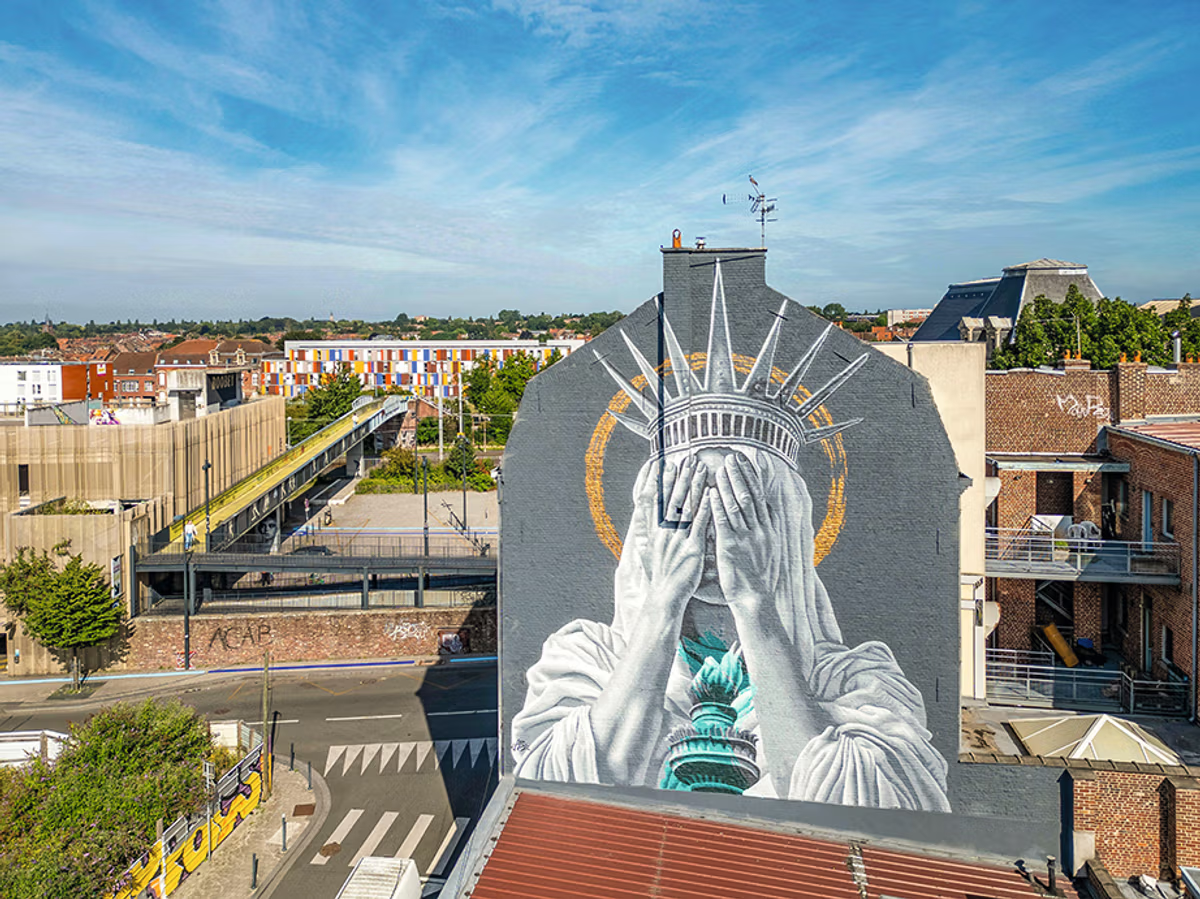
Concerns about political interference reached a boiling point in July when painter Amy Sherald, celebrated for her 2018 portrait of Michelle Obama, withdrew from a major exhibition scheduled for the National Portrait Gallery. The show would have marked the institution’s first solo presentation by a Black contemporary artist. Sherald said she made the decision after learning that her painting depicting a Black transgender Statue of Liberty might be removed to avoid provoking the Trump administration. The work had previously appeared in other museum iterations of the exhibition and later graced the cover of The New Yorker.
“When governments police museums,” Sherald wrote in an MSNBC op-ed, “they are not simply policing exhibitions—they are policing imagination itself.” Her decision inspired other artists to take similar stands.
In September, Nicholas Galanin withdrew from a symposium connected to The Shape of Power: Stories of Race and American Sculpture at the Smithsonian American Art Museum after the event was quietly made private and restricted from public documentation. Galanin argued that these conditions effectively censored participants. Museum representatives denied the accusation.
The Whitney’s ISP Program Faces Fallout
Outside Washington, no institution faced greater political turbulence in 2025 than the Whitney Museum of American Art. In May, the museum canceled a pro-Palestine performance planned for its Independent Study Program. The following month, it eliminated the position of associate director Sara Nadal-Melsió, prompting widespread backlash.
Artists and scholars protested publicly, and more than 100 figures—including Emily Jacir, Hans Haacke, and Michael Rakowitz—signed an open letter condemning Nadal-Melsió’s dismissal as emblematic of a broader climate of institutional repression. Nadal-Melsió herself later wrote that the ISP had always been deeply engaged with the political realities of its moment—and that this commitment now placed its independence at risk.
Sally Mann and the Texas Culture Wars
In Texas, the conservative assault on the arts took a dramatic turn when police seized photographs by Sally Mann from a group exhibition at the Modern Art Museum of Fort Worth. The images—decades-old photographs of her children taken in rural Virginia—were investigated on allegations of child pornography, despite long-standing recognition of their artistic merit.
Although the photographs were ultimately returned following a costly investigation, the incident coincided with proposed legislation that would impose steep penalties on museums displaying material deemed “obscene.” Speaking to NPR, Mann warned that the culture wars were entering a more dangerous phase, fueled in part by the amplifying power of social media.
Australia’s Venice Biennale Controversy
At the international level, political pressure surfaced dramatically in the lead-up to the Venice Biennale. Lebanese-born artist Khaled Sabsabi and curator Michael Dagostino were initially selected to represent Australia in 2026—only to have their appointment abruptly revoked by Creative Australia. Although the decision was later reversed, the episode led to multiple resignations within the organization and heightened fears that artists critical of Israel face increasing censorship worldwide.