

The zombie genre may shuffle forward endlessly, but it never truly collapses. While countless filmmakers have tried to refresh the familiar cycle of death, resurrection, and decay, originality has become harder to unearth. Australian director Zak Hilditch’s We Bury the Dead steps into this crowded graveyard with a quieter, more reflective approach. Though its themes of grief and mourning are no longer groundbreaking in horror cinema, the film still finds space to resonate thanks to its restraint and emotional focus. This balance is at the heart of We Bury the Dead Review: Daisy Ridley Delivers a Compelling Performance in a Fresh Zombie Twist.
Rather than leaning heavily into nihilism or self-important gloom, Hilditch keeps the story grounded. Yes, the film is about loss and trauma, but it never forgets it’s also a survival thriller. Audiences expecting relentless gore—especially given its early January release slot, often reserved for disposable horror—may be surprised. We Bury the Dead, which received support from the Adelaide Film Festival before debuting at SXSW, is far more interested in emotional fallout than body counts. The catastrophe at its center is a massive U.S. military error that wipes out hundreds of thousands of lives in Tasmania, leaving behind a population struggling to cope with sudden, unimaginable loss.
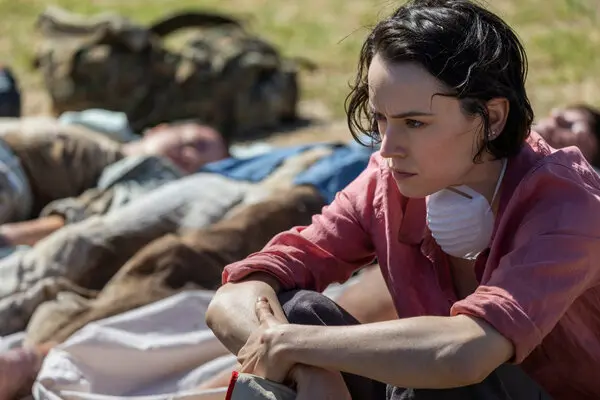
At the center of the story is Ava, played by Daisy Ridley, an American woman who travels to Tasmania to assist in a volunteer recovery operation. Officially, the mission is about cataloguing and identifying the dead. Personally, Ava is searching for her husband, who was killed in the disaster and left somewhere beyond the safe zones. Her presence is not warmly received—many locals still blame the U.S. for the tragedy—but she finds an uneasy ally in Clay (Brenton Thwaites), a rule-bending volunteer willing to help her venture into restricted territory. Complicating everything is a disturbing development: some of the bodies are starting to move.
Interestingly, the film avoids the usual hysteria associated with the undead. There’s little explanation for why some corpses reanimate while others remain lifeless, and fear is initially replaced with confusion. Zombies are treated almost as an anomaly rather than an immediate threat, as though this world has never encountered the concept before. Only when the reanimated dead grow more volatile does panic set in. Ava, however, remains focused on her grief. Ridley plays her as a woman barely holding herself together, haunted by the possibility that her husband might be among the waking dead—and unsure whether that knowledge would offer comfort or deepen the pain.
Since stepping away from the Star Wars spotlight, Ridley has found her strength in smaller, more character-driven projects. After uneven big-budget efforts like Chaos Walking, she’s thrived in intimate roles that demand nuance. Her performances in Sometimes I Think About Dying and the underseen thriller Magpie showcased her ability to convey anxiety, menace, and vulnerability with minimal dialogue. She brings that same precision here, elevating a lightly sketched character into something deeply human. Ava’s sorrow, fear, and determination are communicated largely through Ridley’s expressive face and controlled physicality, making her the emotional backbone of the film.
Visually, Hilditch is confident. He captures Tasmania’s rugged landscapes with striking beauty, often making the film feel far larger than its budget suggests. However, tonal consistency proves more elusive. Some sequences glide effortlessly between melancholy and tension—such as a memorable moment involving a grieving soldier and an unexpected dance—while others feel disjointed. Quiet introspection is occasionally undercut by abrupt musical cues or familiar bursts of zombie action that don’t always land.
By the time Ava’s journey concludes, it’s clear that We Bury the Dead isn’t reinventing the undead mythos. Its final act poses questions that genre fans have seen before, and the ending lacks the punch it seems to promise. Still, in a landscape crowded with lazy horror entries, this film’s sincerity and effort stand out. It may not change the zombie genre forever, but it proves that even well-worn territory can feel meaningful when explored with care—and anchored by a performance as compelling as Ridley’s.