

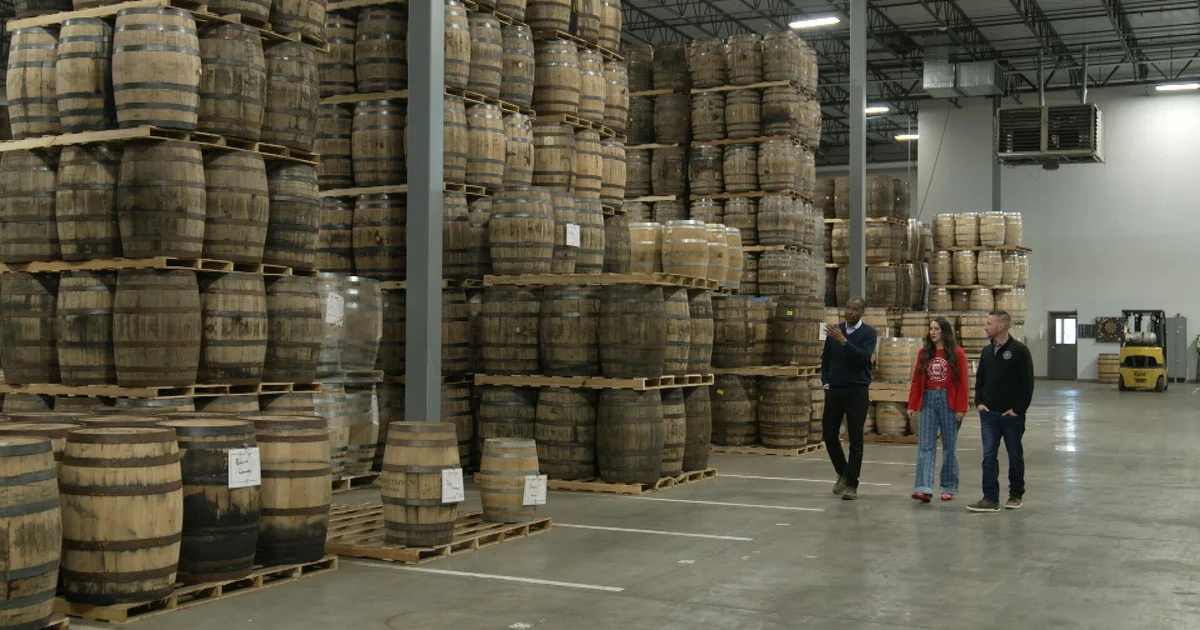
If someone asked you to name a product that was first made 2,000 years ago, still looks and works as it always has, and still plays a vital role in global commerce, would you be stumped?
It turns out, the answer is the simple wooden barrel. Almost always made of oak, barrels have a long and fascinating history. First built and used by the Celts and Romans, they have held nearly every commodity over the centuries.
Metal and plastic and cardboard long ago eclipsed barrels for the shipment of most items, but as we first reported earlier this year, when it comes to wine and whiskey – especially bourbon whiskey – the oak barrel still reigns, not just as a container, but for the magic that the wood gives the whiskey.
Bill Whitaker: Well we were speaking with someone. And they called a whiskey barrel a breathing time machine.
Brad Boswell: I love that.
Brad Boswell is the CEO of Independent Stave, the largest maker of wooden barrels in the world. Brad’s great-grandfather founded the company in 1912 in Missouri. It now has operations worldwide; we met him in Kentucky.
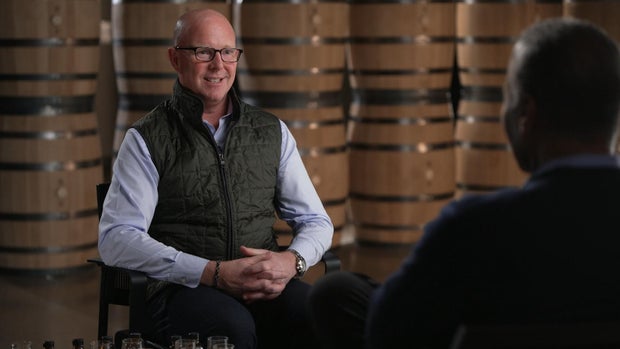
Brad Boswell: Most of our barrels would have useful lives of 50+ years.
Bill Whitaker: Fifty plus years.
Brad Boswell: Fifty plus years, yeah. Like, I’ll go to different places and look at barrels at distilleries or wineries around the world. And I can see barrels that my grandfather made, you know, in the 1960s. I still see ’em.
A barrel begins as a log from a white oak tree fed into what’s known as a stave mill, where it’s cut into ever-smaller pieces – staves – which are then arranged in huge “Jenga”-style stacks and “seasoned” outdoors for three to six months before heading to a nearby “cooperage,” where the barrels are built.
Brad Boswell: There’s no nails, look over here, no glue —
Brad Boswell’s newest cooperage produces thousands of barrels every day.
Bill Whitaker: How many of these go into a typical barrel?
Brad Boswell: Typically between 28 and 32 staves per barrel.
After a barrel is “raised” mostly by hand, it travels through a host of other steps and checks to make it ready to begin its life, including being toasted and then charred on the inside.
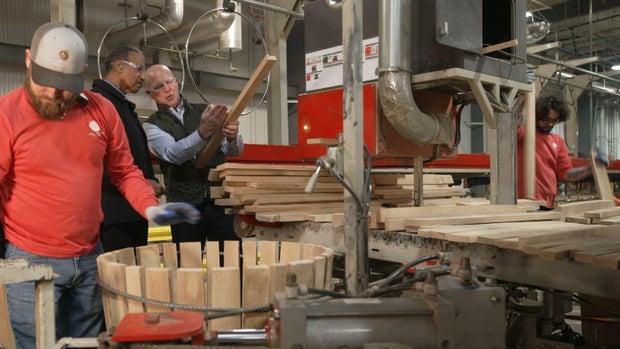
Brad Boswell: Most of the barrels we make today are bespoke. We know exactly who this barrel’s going to, which distillery.
Bill Whitaker: How about that. How about that.
The demand for such a huge volume of barrels can be attributed mainly to one thing: bourbon.
Brad Boswell: President Franklin Roosevelt in the ’30’s became more specific about what bourbon whiskey should be. And at that time he said, you know, bourbon should be in new charred oak barrels.
Bill Whitaker: So if it’s not in one of these barrels, it’s not bourbon?
Brad Boswell: That’s correct. Bourbon has to be aged in a new charred oak container.
That rule, plus booming consumer demand for bourbon starting in the early 2000’s, has been very good for the barrel business. 3.2 million new barrels were filled with whiskey last year in Kentucky alone, and more than 14 million full barrels are aging in the state, in massive warehouses known as rickhouses.
Bill Whitaker: How many– barrels are in this rickhouse?
Dan Callaway: 23,500 on six floors.

Dan Callaway is the “master blender” for Bardstown Bourbon, a young but fast-growing Kentucky distillery.
Dan Callaway: To make a great whiskey you have to start with a great distillate, a clear spirit. But then the magic comes from the barrel. The fact that it’s new charred oak, it’s just incredible.
Bill Whitaker: So the– the barrel is– is crucial to your product?
Dan Callaway: Absolutely. Depending on who you talk to– some would say 50% of the flavor, maybe up to 70-80% of the character is derived from that barrel.
The rest of the flavor comes from what’s known as the “mash bill,” grains like corn and wheat and rye that are mixed with water and fermented with yeast.
Despite bourbon having recently been threatened or hit with tariffs by other countries in retaliation for President Trump’s tariffs, Bardstown’s huge distillery is still producing enough new whiskey to fill more than 5,000 barrels a week.
Bill Whitaker: You take the– the clear liquid, which is basically what people call “moonshine,” goes through this process and comes out as this beautiful brown, tasty liquid here. How does that happen?
Dan Callaway: Yeah, so I always compare it to a seesaw, okay? So when it comes off the still– moonshine, like you said– it’s a seesaw that’s out of balance. But every year that goes by of the barrel aging, the seesaw comes into balance. And what the barrel is bringing is caramel, vanilla, baking spice – and all this rich, beautiful color.
How can solid oak produce all those flavors and spices? Back where the barrels are built, Brad Boswell gave us a vivid lesson with a barrel that had just been toasted — a process that brings sugars in the wood to the surface.
Brad Boswell: Smell that. Smell that. I mean-
Bill Whitaker: That does smell delicious.
Brad Boswell: It’s incredible.
Bill Whitaker: It really does. It’s amazing.
Brad Boswell: There’s a reason why people still use oak barrels 2,000 years later.
Bill Whitaker: So when I’m sipping the bourbon, I’m sipping this barrel.
Brad Boswell: That’s right, absolutely.
After toasting, we, and the barrels, moved to the visually stunning “char” oven.
Brad Boswell: So we’ll see this barrel coming through right here.
Bill Whitaker: Oh, look at that.
Brad Boswell: Yeah. So actually, the inside of the barrel is on fire.
Bill Whitaker: They just light the barrel on fire?
Brad Boswell: Yup, we light the barrel on fire, and that teases out more and more of the flavors. And we call that an alligator char, ’cause the inside of the barrel actually looks like kind of an alligator’s back.
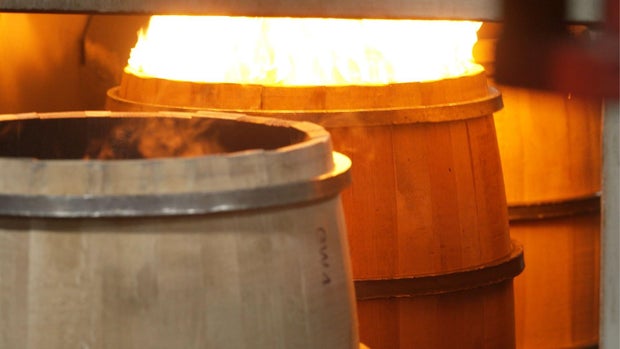
We could see that blistering inside a newly-charred barrel pulled off the line.
Brad Boswell: I mean people, you know, expect this to smell like a campfire. It smells more like a confectionery product.
Bill Whitaker: It does– I can smell the caramel and the vanilla.
What that barrel can give to the whiskey is evident in these glasses.
Brad Boswell: So this is the same exact distillate that came off the still at the exact same time, went into a barrel. Four years later. And this we just kept in a glass bottle.