


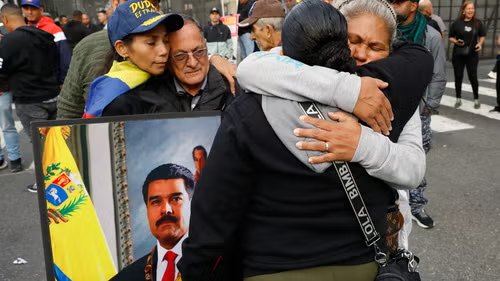
The dramatic capture and transfer of Venezuelan strongman Nicolás Maduro and his wife from their presidential residence in Caracas to federal custody in Brooklyn has been framed by supporters as an extraordinary strategic achievement. Carried out without American casualties, the operation is being hailed as a decisive tactical success that reshapes political, economic, and security dynamics across the Western Hemisphere and beyond. As Conrad Black: U.S. Operation to Oust Maduro Is a Remarkable Strategic Victory, proponents argue that this single move dismantles one of the world’s most entrenched anti-Western regimes.
A Blow to Authoritarianism in the Americas
Maduro’s removal is seen as eliminating a critical node in the network of governments hostile to the United States. It strengthens the broader shift toward center-right, democratic leadership in Latin America and delivers a serious setback to narco-terrorist groups that have long antagonized Washington. Analysts also suggest it severs Venezuela’s role as a financial and logistical lifeline to Nicaragua’s Marxist leadership.
The move has already been interpreted as a warning shot to Colombia’s president, Gustavo Petro, whose administration has drawn criticism for its perceived leniency toward narcotics networks. The revocation of Petro’s U.S. visa after a controversial New York speech underscored Washington’s harder line on regional leaders it views as undermining American security interests.
Mexico, Cuba, and the Border Question
Attention is now turning northward. Mexico faces growing pressure over criminal syndicates that effectively control parts of its territory, as well as its continued diplomatic support for Cuba’s communist government. With the U.S. border sealed more tightly and deportations of convicted criminals accelerating, the message is clear: tolerance for cross-border criminal governance is waning.
Oil, Europe, and the Ukraine War
Perhaps the most far-reaching consequence lies in energy policy. Donald Trump has pledged to reintroduce American oil companies to Venezuela, with the aim of tripling production to pre-nationalization levels. Such a surge could dramatically raise living standards for Venezuelans—adding an estimated $4,000 per capita—while also stabilizing global energy markets.
In geopolitical terms, this would free roughly two million barrels of oil per day for Western Europe, cutting off billions in revenue currently flowing to Russia. That financial squeeze directly impacts Moscow’s ability to sustain its war in Ukraine, shifting leverage back toward Washington and its allies.
Russia Under Pressure
With Europe being pressed to raise defense spending and purchase U.S.-made weapons for Ukraine, Russia’s economic vulnerabilities are becoming more exposed. Vladimir Putin now faces a conflict that bleeds resources for minimal territorial gain. The notion of post-Soviet Russia rapidly re-emerging as a superpower has faded; its shrinking population and modest GDP underscore the limits of its endurance.
Trump’s strategy, supporters say, is calibrated not to humiliate Moscow but to prevent Russia from collapsing into dependency on China. The longer the Kremlin delays a negotiated exit, the fewer options it retains.
The Legal and Moral Debate
Critics argue that forcibly removing a sitting head of state violates international law. Supporters counter that Maduro forfeited legitimacy by rigging elections, dismantling democratic institutions, and presiding over systemic repression. With U.S. indictments already in place and narco-terrorism framed as a direct threat to American security, the administration maintains it acted within its constitutional duty to defend the nation.
While the invocation of the Monroe Doctrine has sparked debate, advocates suggest a modern interpretation is needed—one that allows the U.S. to counter genuine security threats in the hemisphere while respecting sovereign relationships elsewhere.
A High-Stakes Gamble Paying Off—So Far
From confronting China’s regional influence to pressuring Russia and reasserting control in the Americas, Trump’s foreign policy approach is portrayed by allies as assertive but strategic. Venezuela, Iran, and other adversarial states have felt the weight of this posture, reshaping global power calculations in real time.
Whether history ultimately judges these actions as prudent defense or dangerous overreach remains to be seen. For now, supporters insist the cards have been played with precision—and the balance of power has shifted accordingly.