

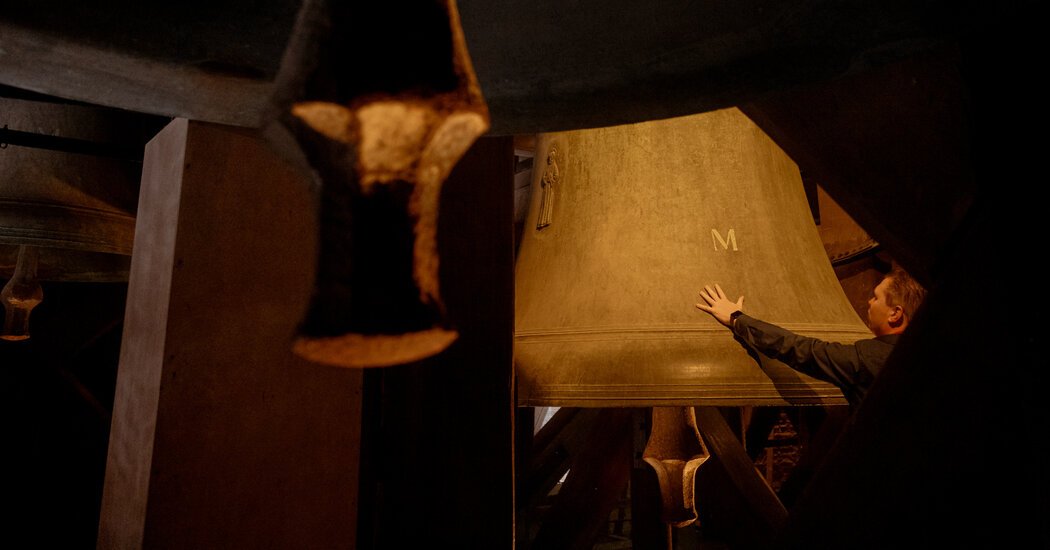
In a diary entry in the summer of 1943, Anne Frank wrote that she had lost all sense of time. The bells in Amsterdam’s tallest church tower, the Westertoren, right next to her own attic hiding place in a canal house, had stopped ringing.
“For a week already we’ve all been a little confused about the time, ever since our dear and precious Westertoren bell has apparently been hauled away for factory use,” she wrote on Aug. 10, 1943, “and we don’t know precisely what time it is, neither day or night.”
News had reached the young diarist in her terrified seclusion that the Nazi occupiers in Holland were confiscating church bells across the country, to melt them down for weapons and ammunition. “I still have some hope that they will invent something that will remind the neighborhood a bit of the clock,” she added.
During World War II, Hitler’s Germany requisitioned some 175,000 church bells from across Europe, so that they could extract their metal components, mostly copper and tin.
The vast majority of those, some 150,000 bells, were never returned to their churches. Many others were destroyed in the removal process, smelted and converted into munitions, and thousands ended up in so-called “Glockenfriedhöfe,” or bell cemeteries.
The destruction of church bells, viewed as a war crime during the 1945 Nuremberg War Tribunal and as an act of sacrilege by the Roman Catholic church, is a lesser-known aspect of Nazi looting. Many cities and towns that had for centuries measured out their lives by the quotidian chiming of church bells, now fell silent.

The Music of Bells Has ‘Psychological Significance’
The confiscation had an immediate impact on the lives of ordinary Europeans, who kept time by church bells that typically chimed once every quarter of an hour, and played melodies on the hour.
“It marks the rhythm of people’s days, the rhythms of their lives,” said Kirrily Freeman, a history professor at St. Mary’s University in Nova Scotia, who has written extensively about military use of metals, including bells, during World War II. “It’s something that calls people together for major life events, weddings, baptisms, funerals.”
Church bells in European countries had “personal, familial, community and maybe even psychological significance,” for a large part of the churchgoing public, Freeman added. “To lose that, not voluntarily, and especially because it was often done violently and in the context of occupation, well, the consequences would be enormous.”
The musical loss, according to the historian Carla Shapreau, a senior fellow with the Institute of European Studies at the University of California, Berkeley and founder of the Lost Music Project, left “a sonic gap in the European landscape.”
It took nearly two decades for most of these bells to be replaced, said Rainer Schütte, a historian and curator of bells at the Klok and Peel Museum in Asten, the Netherlands, a museum devoted to the history of bells and carillons (a more intense, keyboard-played musical experiences).
“In many places, they engaged in getting new bells made and also sometimes adding carillons,” Schütte said. Often the carillons were introduced as a kind of memorial for victims of the war.” Commemorative bells were also given as gifts, like the Netherlands Carillon in Arlington, Va., which the Dutch sent as a token of gratitude for American aid during and after World War II.
The wartime destruction of bells also had a silver lining, giving campanologists an opportunity to study Europe’s bells, and propelling bell foundries to improve their quality and timbre. By 1960, when “almost all the bells had been returned to their towers,” said Schütte, and “the foundries managed to increase their production level, both the quantity of the bells and their quality.”