

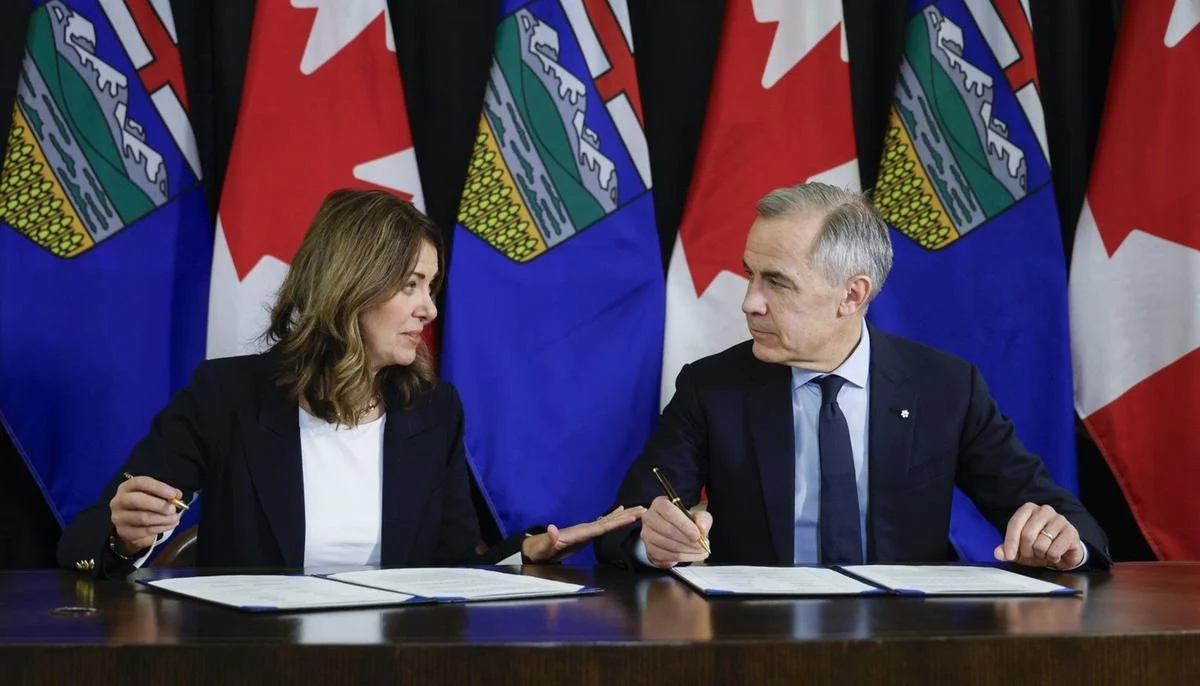
Alberta Premier Danielle Smith is intensifying her push for faster federal approval of a major oil pipeline to Canada’s West Coast, arguing that rising geopolitical uncertainty—particularly developments in Venezuela—has made delay a serious economic risk. The renewed urgency follows a meeting with Prime Minister Mark Carney on Jan. 9, where Smith called for accelerated timelines on major energy infrastructure projects.
Venezuela’s Turmoil Spurs Renewed Urgency
In a letter sent to Carney on Jan. 8, Smith warned that recent events in Venezuela highlight the need to rapidly approve a one-million-barrel-per-day pipeline from Alberta to the B.C. coast, alongside an expansion of the Trans Mountain pipeline. She pointed to strong and growing demand from Asian markets for Canadian oil and cautioned that Canada risks losing its competitive edge if approvals remain slow.
Smith also revealed that Alberta plans to submit its pipeline proposal to Ottawa’s Major Projects Office earlier than expected. While an earlier agreement set a July 1 deadline, the province now aims to file the proposal by June at the latest and is urging Ottawa to shorten the approval window.
“To meet this moment, nation-building projects must move faster,” Smith wrote, arguing that approval timelines stretching up to two years are no longer realistic in a volatile global energy environment.
Balancing Climate Policy and Market Access
The push is rooted in a November memorandum of understanding between Alberta and the federal government, which outlines plans to build one or more pipelines to the B.C. coast if a private-sector proponent emerges. The deal also includes potential changes to several Trudeau-era energy regulations. In exchange, Alberta committed to increasing its industrial carbon tax, cutting methane emissions, and pairing any new pipeline with a large-scale carbon capture initiative.
Smith stressed that while climate commitments matter, Canada must strike a “competitive balance” between carbon pricing and access to global markets. She warned that overly aggressive carbon taxes could leave Canadian oil at a disadvantage compared to producers in the United States, the Middle East, Russia, and Venezuela.
U.S. Signals Add Pressure
The debate gained fresh momentum after U.S. President Donald Trump said American companies would help revive Venezuela’s oil infrastructure and that U.S. refineries would begin processing Venezuelan crude. Both Canada and Venezuela produce heavy crude suited for refineries along the U.S. Gulf Coast, raising concerns about future market share.

Conservative Leader Pierre Poilievre echoed those concerns in a letter to Carney, warning that any increase in Venezuelan exports to the U.S. could crowd out Canadian oil unless new export routes to Asia are approved quickly. Smith later reinforced that message on social media, saying delays could cost Canada investment, jobs, and long-term competitiveness.
Assessing the Real Threat
While Venezuela holds an estimated 303 billion barrels of oil reserves, its industry has suffered decades of decline due to nationalization, sanctions, and corruption. Alberta, by contrast, holds roughly 167 billion barrels of heavy oil reserves valued at more than $9 trillion. Canada currently produces about five million barrels of crude per day, exporting the majority to the United States.
Energy experts caution that Venezuela’s recovery will take time. Richard Masson, an executive fellow at the University of Calgary’s School of Public Policy, said the country’s oil sector would require massive investment and years of rebuilding before it could seriously challenge Canada’s position.
Even so, Smith argues that the moment calls for decisive action. As global energy dynamics shift, she believes Canada must move quickly—or risk falling behind. Her message to Ottawa is clear: bold infrastructure decisions now will determine Canada’s energy future later, reinforcing her central demand—Smith Presses Carney for Rapid Pipeline Clearance as Venezuela Situation Escalates.