

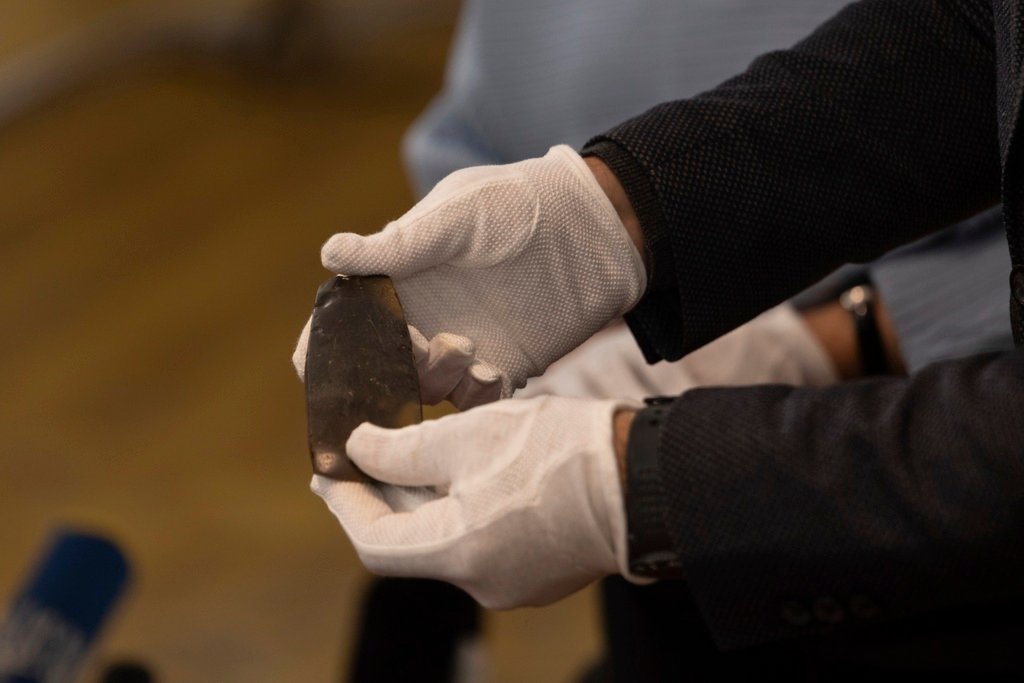
Ukraine has formally asked Poland to extradite an archaeologist detained in Warsaw earlier this month, accusing him of carrying out unauthorized excavations in Russian-occupied Crimea, according to Polish media reports.
The Warsaw District Prosecutor’s Office confirmed it received the extradition request from Kyiv for Oleksandr Butyagin, who was taken into custody on December 4 while visiting Poland.
Butyagin, 52, works at the State Hermitage Museum in St. Petersburg, where he heads the archaeology department focused on the Northern Black Sea region, including Crimea. He was arrested in Warsaw during a European lecture tour, which was expected to conclude in Belgrade. A Polish court has ordered him held in custody until January 13 as extradition proceedings continue.
In November, Ukraine’s Prosecutor General’s Office charged Butyagin with illegally excavating the ancient city of Myrmekion in Crimea’s Kerch district between 2014 and 2019 without authorization from Ukrainian authorities. Prosecutors allege the work caused extensive damage to the site. Ukraine’s security service, the SBU, claimed that Butyagin’s team removed cultural layers of soil to a depth of nearly two meters, with restoration costs estimated at more than 200 million hryvnia (approximately $4.75 million).
Should Polish courts approve his extradition and he be convicted in Ukraine, Butyagin could face a prison sentence ranging from one to ten years.
Russian officials have sharply criticized the arrest. Kremlin spokesperson Dmitry Peskov described the detention as “legal arbitrariness,” while members of the Russian Academy of Sciences dismissed the case as “absurd in its motivations.” The State Hermitage Museum also defended Butyagin, saying he adhered to international standards during the excavations.
According to statements Butyagin gave to Russian state media in 2024, he has overseen work at Myrmekion—an ancient Greek settlement founded in the early sixth century BCE—since 1999. The site, near present-day Kerch, is among numerous heritage locations caught in the legal and ethical disputes stemming from Russia’s 2014 annexation of Crimea and its subsequent invasion of Ukraine.
In May, the European Union imposed sanctions on a Russian museum for the first time over activities linked to Crimea. The Tauric Chersonese State Museum-Preserve and its director, Elena Morozova, were penalized for actions deemed to undermine Ukraine’s territorial integrity and sovereignty.
That move followed calls from a group of art experts urging the International Council of Museums (ICOM) to expel Russia for violating the organization’s ethical guidelines.
Last year, Ukraine accused Russia of turning Tauric Chersonese—a UNESCO World Heritage Site since 2013—into a “historical and archaeological park” and appealed to the United Nations to intervene. Founded by Greeks in the fifth century BCE on the northern coast of the Black Sea, the site has become a flashpoint in the wider dispute over Crimea, whose annexation is not recognized by Ukraine or its allies.
Separately, in November, the Allard Pierson Museum in Amsterdam drew controversy after returning around 400 artifacts—including valuable Scythian gold—to a museum in Kyiv. The items had been loaned to the Netherlands by four Crimean museums before the annexation, and both Ukraine and Crimea later claimed ownership.
“This was a unique situation in which cultural heritage became a casualty of geopolitical events,” said museum director Els van der Plas in a statement.